

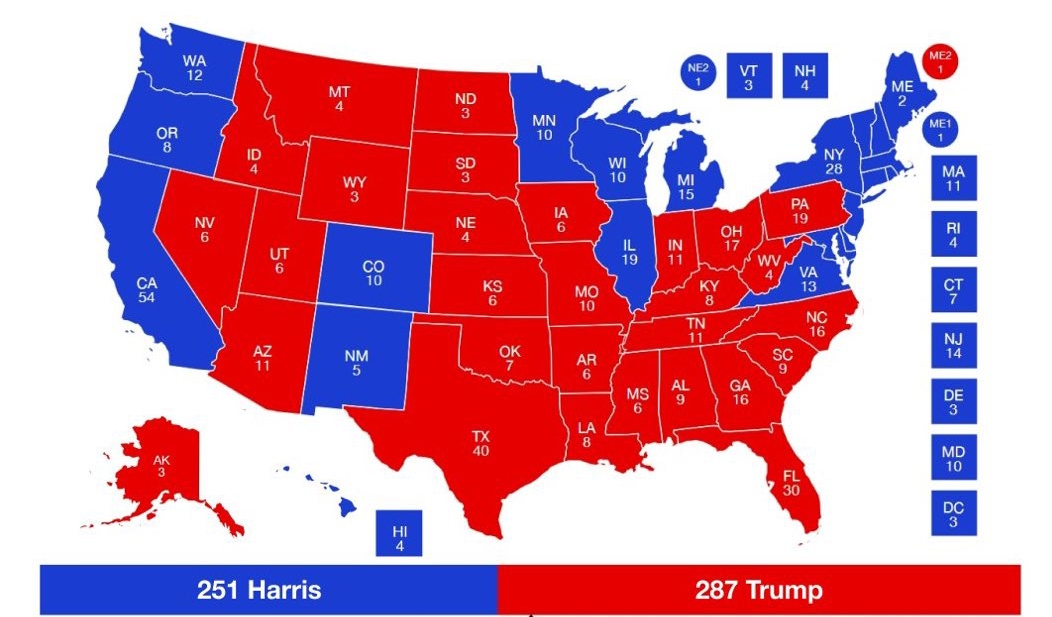
The U.S. electoral system is complex, but it is based on an indirect voting mechanism to elect the president and vice president.
The U.S. electoral system is unique and complex, based on an indirect voting mechanism to elect the president and vice president, known as the Electoral College. This process, established in the Constitution, involves both the popular vote and the allocation of electors by each state, who ultimately decide the outcome of the election.
The Popular Vote and the Electoral College
In the United States, citizens vote for their preferred presidential candidate in each state during the general election, held on the first Tuesday of November every four years. However, the winner is not determined directly by the national popular vote but by the Electoral College, which consists of 538 electors in total. To win the presidency, a candidate must obtain an absolute majority of 270 electoral votes.
Allocation of Electors by State
Each state has a number of electors proportional to its representation in Congress: one for each representative in the House and two for its senators. This means states with large populations, like California, Texas, and Florida, have more electors, while smaller states, like Wyoming or Vermont, have fewer. Most states use a «winner-takes-all» system, in which the candidate with the most popular votes in that state wins all of its electoral votes. Only Maine and Nebraska use a proportional system, allocating some of their electoral votes based on the results in their congressional districts.
What Happens When No Candidate Reaches 270 Electoral Votes?
If no candidate reaches the necessary 270 votes, the election goes to the House of Representatives, where each state casts one vote to choose the president from the top three candidates with the most electoral votes. Meanwhile, the Senate chooses the vice president. This scenario is rare but is outlined in the Constitution.
The Importance of Swing States
Some states are historically Democratic or Republican, but others, known as «swing states,» can lean toward either party in a particular election. These states—such as Florida, Pennsylvania, and Michigan—receive a great deal of attention and campaign resources, as they have the potential to decide the final outcome due to their weight in the Electoral College.
Criticism and Support for the System
The Electoral College has faced criticism and debate, as it allows a candidate to win the presidency without securing the majority of the popular vote, as occurred in the 2000 and 2016 elections. Critics argue that this can distort the representativeness of the system, while supporters maintain that the Electoral College balances the influence of both large and small states and preserves federalism in national politics.
Descubre más desde
Suscríbete y recibe las últimas entradas en tu correo electrónico.














Deja un comentario